
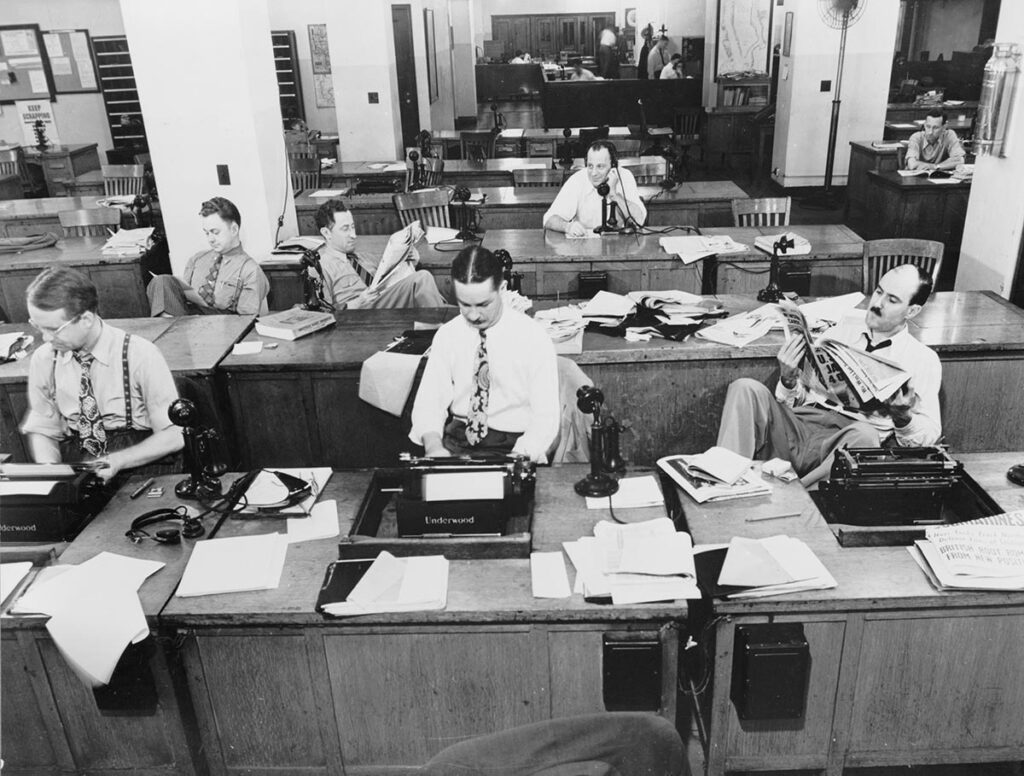
For centuries, newspapers and magazines were the primary way people learned about the world. Long before television broadcasts, radio bulletins, or social media feeds, printed publications informed citizens about politics, business, science, wars, and cultural movements. The history of print journalism is not simply the story of newspapers—it is the story of democracy, public discourse, and the continuous adaptation of journalism to technological change.
Throughout its history, print journalism has repeatedly faced new competitors. First came radio, then television, and more recently the internet and social media. Each innovation was initially viewed as a threat that might render newspapers obsolete. Yet print journalism has survived by evolving, influencing every new medium that followed. Ironically, today’s social media environment may share more characteristics with traditional print journalism than radio or television ever did.
The Birth of Print Journalism
The origins of newspapers can be traced back to the invention of the printing press by Johannes Gutenberg in the mid-fifteenth century. The printing press revolutionized communication by making books, pamphlets, and eventually newspapers available to far larger audiences than ever before.
By the seventeenth century, regularly published newspapers had begun appearing across Europe. They reported political events, trade information, government announcements, and international affairs. Although early publications were often limited by censorship and low literacy rates, they established the foundations of modern journalism.
In the American colonies, newspapers became an essential part of public life. Publications such as The Pennsylvania Gazette, once published by Benjamin Franklin, helped spread political ideas that influenced the American Revolution. Newspapers became places where citizens debated government policies, discussed economic issues, and formed public opinion.
Newspapers Become a Pillar of Democracy
During the nineteenth century, advances in printing technology dramatically reduced production costs.
The introduction of steam-powered presses, cheaper paper, and expanding transportation networks allowed newspapers to reach millions of readers.
At the same time, literacy rates increased, making newspapers accessible to a much larger population.
Journalism evolved beyond government announcements and commercial information. Newspapers began employing professional reporters to investigate crime, politics, business, foreign affairs, and social issues.
The press gradually became known as the “Fourth Estate”—an independent institution responsible for holding governments and powerful organizations accountable.
Investigative reporting exposed corruption, influenced legislation, and helped shape democratic societies.
The Rise of Magazines
While newspapers focused primarily on daily events, magazines developed as publications offering deeper analysis and specialized content.
By the late nineteenth and early twentieth centuries, magazines covered subjects such as:
- politics;
- science;
- literature;
- business;
- fashion;
- technology;
- photography;
- culture.
Magazines introduced long-form journalism, allowing writers to investigate complex topics with greater depth than daily newspapers typically allowed.
Many influential journalists built their reputations through magazine reporting, combining storytelling with extensive research and investigative techniques.
The First Great Competitor: Radio
The arrival of commercial radio during the 1920s represented the first major technological challenge to print journalism.
For the first time, people could hear breaking news immediately instead of waiting for the next morning’s newspaper.
Radio delivered live speeches, election results, sports coverage, weather reports, and wartime updates directly into American homes.
Many newspaper publishers feared radio would destroy the newspaper industry.
Some even attempted to limit broadcasters’ access to news services.
Yet radio ultimately developed a different role.
Its greatest strength was immediacy.
Listeners could hear events as they unfolded, but newspapers continued providing detailed reporting, analysis, investigative stories, editorials, and background information that radio simply could not offer within short broadcasts.
Rather than replacing newspapers entirely, radio changed reader expectations by making speed increasingly important.
Television Changes Journalism Again
Television introduced another dramatic transformation after World War II.
Unlike radio, television combined sound with moving images.
Audiences could now watch wars, elections, presidential speeches, and major historical events unfold before their eyes.
Television quickly became the dominant source of breaking news.
Even so, newspapers retained significant advantages.
A newspaper article could examine complicated political issues over several pages, include detailed interviews, present supporting documents, and provide historical context impossible to deliver during a twenty-minute evening news program.
Television excelled at showing events.
Print excelled at explaining them.
This distinction allowed newspapers and television to coexist for decades despite competing for advertising revenue and audience attention.
The Internet Disrupts the Business Model
The internet represented a far greater disruption than either radio or television.
Unlike previous technologies, online publishing removed many of the economic barriers that had protected traditional newspapers.
Anyone with a computer could publish articles reaching global audiences almost instantly.
Readers no longer needed to purchase printed newspapers.
They could access thousands of news websites free of charge.
At the same time, digital advertising shifted toward search engines and technology companies, dramatically reducing newspaper revenues.
Many newspapers responded by launching websites, introducing digital subscriptions, and investing in multimedia journalism.
The transition was challenging, but many organizations successfully transformed themselves into digital-first newsrooms.
Social Media: A New Competitor—or Something Different?
When social media emerged in the mid-2000s, many observers predicted another crisis for journalism.
Platforms such as Facebook, X (formerly Twitter), Reddit, LinkedIn, Instagram, and later TikTok became important sources of news discovery.
Instead of visiting newspaper websites directly, users increasingly encountered articles through social feeds.
At first glance, social media appeared to be another powerful competitor similar to radio or television.
However, the relationship is more complex.
Unlike radio and television, which primarily distribute professionally produced content in one direction—from broadcaster to audience—social media is fundamentally interactive.
Users can comment, respond, debate, share, quote, and even challenge published stories.
In many respects, this resembles the historical role of newspapers more than broadcast media.
Why Social Media Resembles Print Journalism
Although social media relies heavily on video and multimedia, much of its communication remains text-based.
Articles are shared as headlines accompanied by written summaries.
Discussion occurs through comments, replies, quotes, and long-form posts.
Readers often engage directly with journalists.
Opinion pieces generate public debate.
Investigative articles are dissected, analyzed, criticized, and expanded upon by thousands of readers.
This dynamic mirrors the public conversation that newspapers historically encouraged through editorials, letters to the editor, opinion columns, and reader responses.
Rather than simply consuming information, audiences actively participate in its interpretation.
In this sense, social media has revived one of print journalism’s oldest traditions: public debate.
The New Challenges
Despite these similarities, social media has introduced serious challenges for journalism.
The speed of online publishing encourages immediate reactions rather than careful reflection.
Algorithms often prioritize engagement over accuracy, rewarding emotionally charged content and sensational headlines.
Misinformation can spread rapidly before professional journalists have time to verify facts.
The economic relationship between publishers and audiences has also changed.
Instead of owning the distribution channel, news organizations often depend on technology platforms whose algorithms determine whether articles are widely seen.
This has reduced publishers’ control over audience reach while increasing competition for attention.
The Future of Print Journalism
Despite repeated predictions of its demise, print journalism has demonstrated remarkable resilience.
Many newspapers now operate as digital news organizations while maintaining the editorial principles developed over centuries.
Long-form investigative reporting remains highly valued.
Readers continue seeking trustworthy analysis that goes beyond short videos or viral posts.
Artificial intelligence, newsletters, podcasts, and subscription-based publishing are creating new opportunities for journalism to reach audiences directly without relying entirely on social media platforms.
Rather than replacing journalism, technology continues to reshape how journalism is produced and consumed.
Conclusion
The history of print journalism is one of constant adaptation. Newspapers survived the arrival of radio by emphasizing depth over speed. They adapted to television by providing context that broadcasts could not. They reinvented themselves again during the internet revolution by embracing digital publishing.
Today, social media presents both the greatest challenge and perhaps the greatest opportunity in the history of journalism. While platforms have disrupted traditional business models and accelerated the spread of misinformation, they have also revived a central characteristic of print journalism: public conversation through written communication.
Unlike radio and television, which largely speak to audiences, social media allows audiences to speak with journalists and with one another. The exchange of ideas, opinions, criticism, and evidence resembles the public forums once created by newspapers and magazines, albeit on a global and instantaneous scale.
The future of print journalism will not depend on paper or printing presses. It will depend on the values that have always defined great journalism—accuracy, independence, accountability, and thoughtful storytelling. As technology continues to evolve, those principles remain as relevant today as they were when the first newspapers rolled off the printing press centuries ago.